This website provides an independent perspective on the Santa Marta Process by LINGO and is not the official website of the First Conference in Santa Marta.
Implementing the transition beyond fossil fuels
Santa Marta Process
A collaborative international initiative for advancing beyond fossil dependency towards a world in balance: prosperous, healthy and socially just.
Santa Marta Process Building Blocks
Implementing the transition beyond fossil fuels
Case studies
Central Banks
What is happening
The Santa Marta Transition and Financial Stability Group, (SMarT FSG) was set up in Santa Marta as a community of practice of central bankers and others to address the challenges of fossil fuel dependency for financial stability.
What is next
A programme of research, analysis, tool development and piloting is currently being designed and a diverse event programme is underway. Learn more on the SMarT FSG website.
Who is doing it
A community of central bankers, policymakers, researchers, and civil society organisations committed to accelerating the transition away from fossil fuels and to building a clean, inclusive, and stable energy system through a just and orderly transformation. The SMarT FSG is facilitated by WRI, LINGO, and the Caribbean Policy Development Centre.
What is the problem?
Fossil fuels are a source of systemic financial instability as evidenced not least by fossil fuel price spikes in 2026.
Case studies
Health
What is happening
The Health Ministry in Colombia is currently considering hosting a National Dialogue on the Health Benefits of Fossil Fuel Phase-Out.
Who is doing it
The Colombian Health and Environment Ministries are in early discussion with representatives from George Mason University, Lancet Countdown, and the Global Climate and Health Alliance about how their organizations can support the national dialogue process.
What is the problem?
The profound health benefits and health cost-savings associated with phase-out are rarely considered by energy policymakers. Bringing these into focus will accelerate the pace of phase-out.
What is next
Funding is being sought to develop resources that will assist all interested countries in conducting their own National Dialogue on the Health Benefits of Fossil Fuel Phase-Out.
Case studies
Methane
What is happening
The Santa Marta Fossil Methane Circle is coordinating activities to pull the Methane Emergency Brake.
What is next
A Zero Methane Technology Standard, a work programme on Methane & Health, Revealing Methane as Red and more.
Who is doing it
Individuals and organizations that participated in the Methane Workstream in Santa Marta are continuing to coordinate for high-impact activities.
What is the problem?
Methane is one of the worst offenders when it comes to causing heat - and one of the biggest opportunities when it comes to dialing it down. And fossil methane should be easy to cut - but it’s hardly happening. The Santa Marta Process will try to unblock the Methane Emergency Brake.
Case studies
Fossil Free Zones
What is happening
A Registry of Fossil Free Zones will show which places in the world have already prohibited fossil fuel extraction.
What is next
Launch of the Fossil Free Zones Registry.
Who is doing it
Universities, think thanks and CSOs are bringing together existing databases of bans, moratoria, community resolutions to outlaw fossil fuel extraction in specific places.
What is the problem?
There are already places that do not allow fossil fuel extraction, all the way from community to continent level - but they are not very visible. The Fossil Free Zones Registry will make them more visible and allow countries to showcase their commitment in moving beyond fossil fuel extraction by formally registering it.
Case studies
Fossil Fuel Treaty
What is happening
A Fossil Fuel Treaty is a long-standing proposal of dealing with climate change and is supported by about half the Santa Marta Process countries.
What is next
Progress towards a Fossil Fuel Treaty is expected to be one of the topics of discussion at the next Conference in Tuvalu in 2027.
Who is doing it
A coalition of countries, brought together by the Fossil Fuel Treaty Initiative are coordinating on how to work towards such an instrument.
What is the problem?
Time and again, action on fossil fuels, even just language on it, has been thwarted by fossil fuel interests at the UNFCCC. A dedicated instrument that makes a transition away from fossil fuels legally binding could be an important step forward.
Case studies
SP-GET
What is happening
The Science Panel for the Global Energy Transition (SP-GET) will supply governments and multilateral contexts with advice and data in their transitions beyond fossil fuels.
What is next
Formal launch of the panel. Its first report is expected at COP31.
Who is doing it
SP-GET will be chaired by Dr Vera Songwe (Cameroon), Professor Gilberto M. Jannuzzi (Brazil) and Professor Elmar Kriegler (Germany). Together they will coordinate the efforts of around 80 scientists in four expert groups on Transition Pathways, Technology, Policy Design & Evaluation, and Finance, to provide state-of-the-art and balanced scientific information in support of the transition away from fossil fuels.
What is the problem?
The energy transition is moving fast, as is the world around it. SP-GET aims to provide annual, targeted input to the TAFF process to ensure that governments are equipped with up-to-date scientific information.
Case studies
Arbitration
What is happening
Coming soon
What is next
Coming soon
Who is doing it
CEPR & partners
What is the problem?
Coming soon
Case studies
Zero Carbon Prosperity
What is happening
The concept of Zero Carbon Prosperity has been explored in some depth in Santa Marta and is currently being developed further to guide efforts for transitioning beyond fossil fuels and human development more generally.
What is next
The first International Conference on Zero Carbon Prosperity will take place in Guangzhou, China from October 26-28, 2026.
Who is doing it
HKUST-GZ & partners
What is the problem?
Taking down fossil fuels before building the alternatives may not be viable. Zero Carbon Prosperity focusses on the constructive part of the process - building well-being without fossil fuels.
Case studies
Fossil Free Trade
What is happening
A Workstream on Trade Dimensions of the Transition Beyond Fossil Fuels has been formally launched in early August.
What is next
An event programme to be announced.
Who is doing it
OECD, South Centre & additional organizations
What is the problem?
Coming soon
Case studies
Transparency
What is happening
Coming soon
What is next
Coming soon
Who is doing it
The COFFIS Secretariat, hosted by IISD and the Netherlands
What is the problem?
Coming soon
Case studies
Roadmaps
What is happening
A formal Workstream on Roadmaps for Transitioning Away from Fossil Fuels has been launched in early August 2026.
What is next
Further details are to be announced.
Who is doing it
NDC Partnership, SPGET & partners
What is the problem?
Coming soon
Case studies
Dialogues of Origin
What is happening
Coming soon
What is next
Coming soon
Who is doing it
Mamos of the Sierra Nevada de Santa Marta
What is the problem?
Coming soon
Outcomes
- Second Conference in Tuvalu announced
- France presented National Fossil Fuel Phaseout Roadmap
- Central Banker’s SMarT FSG established
- Science Panel for the Global Energy Transition announced
- Finance, Trade and Roadmaps Workstreams announced, supported by IISD, CEPR, OECD, SP-GET and NDC Partnership
- Transparency Initiative: COFFIS offer to countries to help with fossil fuel subsidy analysis
- Roadshow about the Santa Marta Process at London Climate Action Week, COP31 and beyond announced by Colombia & Netherlands
1st Conference on Transitioning Away from Fossil Fuels Report
Facts and Figures
Media Coverage
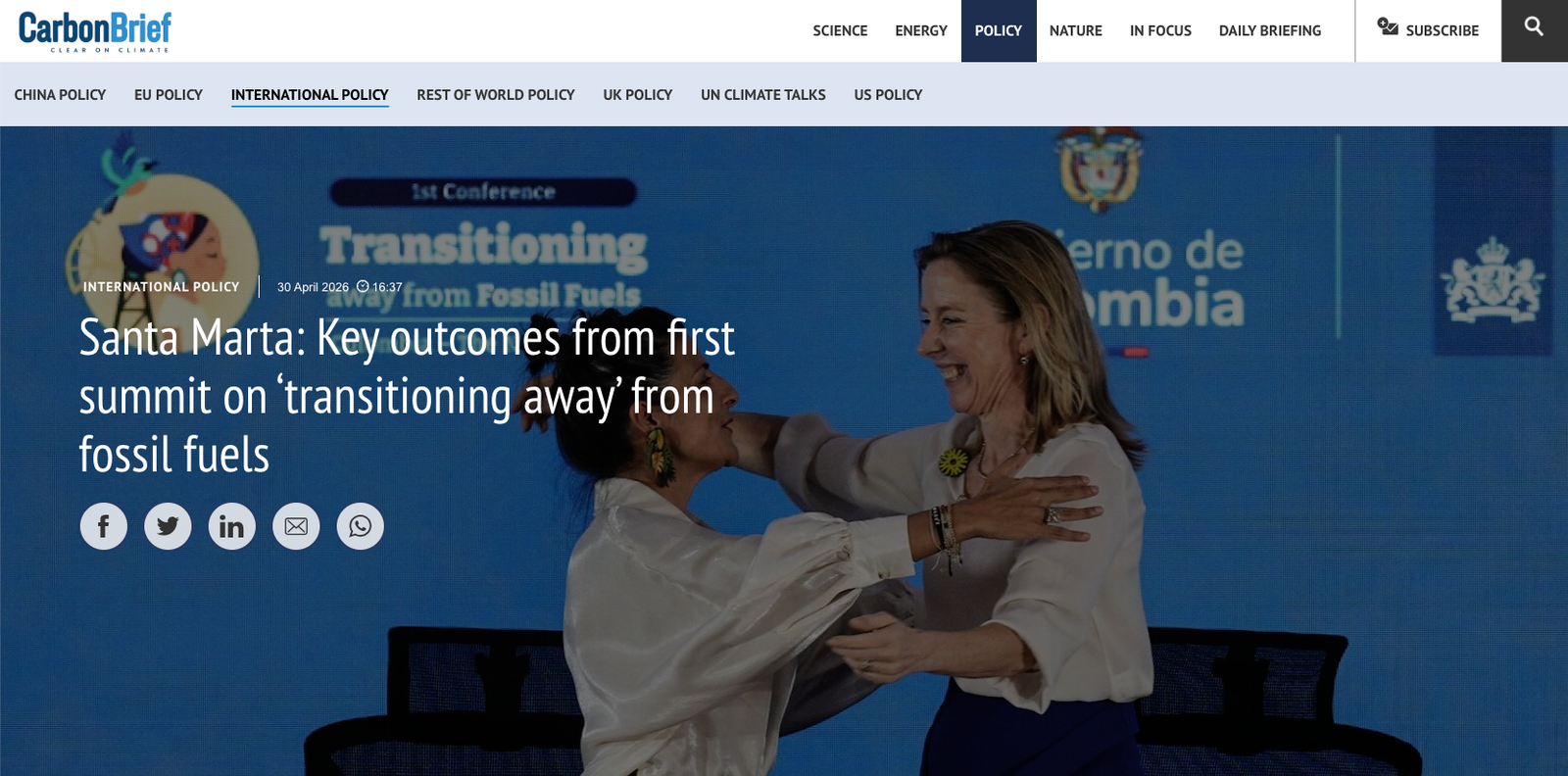
Santa Marta: Key outcomes from first summit on ‘transitioning away’ from fossil fuels
Carbon Brief
The messy, chaotic and possibly quixotic quest to phase out fossil fuels. The inside story of a climate summit unlike any other.
Financial Times
Hope is contagious and science is king: 10 big lessons on ending the fossil fuel era Read More
The Guardian
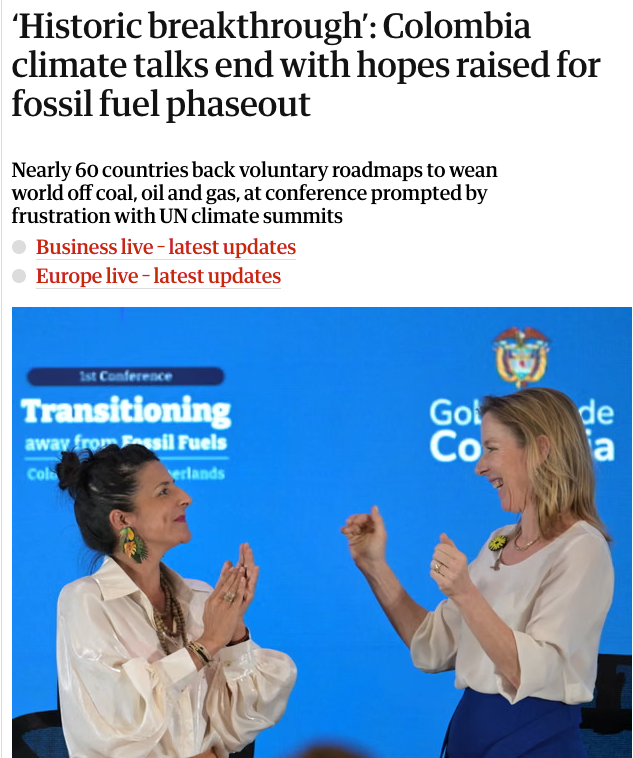
‘Historic breakthrough’: Colombia climate talks end with hopes raised for fossil fuel phaseout
The Guardian
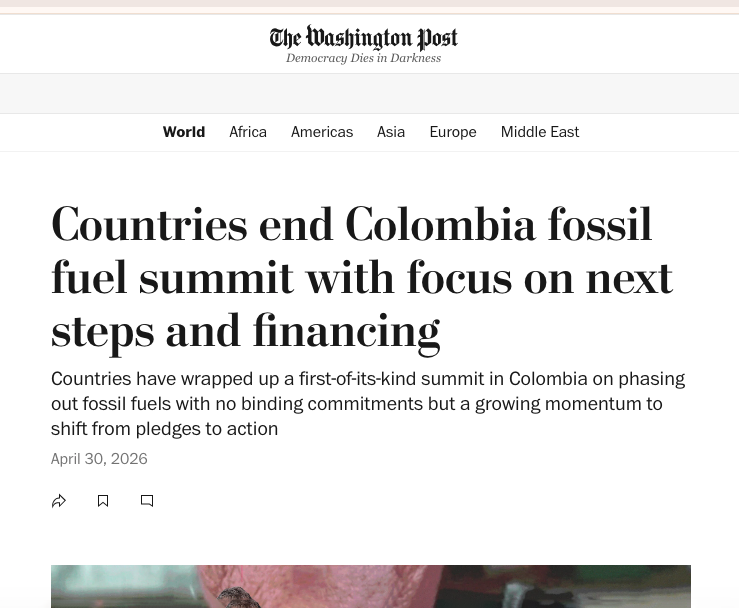
Countries end Colombia fossil fuel summit with focus on next steps and financing
The Washington Post
What is the Santa Marta Process?
Why it exists
The Santa Marta Process emerged to address a critical gap in climate governance: the inability of international negotiations to adequately confront fossil fuel dependency
How it works
A coalition-driven process focused on implementation, practical collaboration, and accelerating fossil fuel transition initiatives.
SANTA MARTA PROCESS
Guiding Principles
The Santa Marta Process is built on collaboration across diverse regions, perspectives, and leadership models to accelerate collective action. The following principles are not explicitly agreed principles that all participants in the process subscribe to or practice to the same degree. They represent a mix between observations of participants and declared goals by the co-hosts and other stakeholders.
Shared Leadership
The process is intentionally co-facilitated by countries from the Global South and Global North, reflecting a model of shared ownership and collective action.
This principle has shaped the first conferences, co-hosted by Colombia and the Netherlands, followed by Tuvalu and Ireland, bringing diverse regional perspectives into the process.
The Academic Dialogue expanded this model through gender-balanced South North co-facilitation across its workstreams.
Implementation Focus
The focus is on the how of the transition beyond fossils. A self-selected group of actors who want to work on that have come together in the Santa Marta Process. It is a coalition of the willing (some prefer Coalition of the Doers) by default, and this also applies to its activities - as not all topics will be equally interesting to all countries and stakeholders, inside the process, smaller coalitions of the willing are taking up specific issues and moving them forward.
Collaboration, not Negotiation
Progressive and determined action emerges from within an individual, institution or state. Where there is a will, there is a way. The process serves to catalyze the will via collaborative engagement and to map the way. This also means that text-based negotiation is not necessary, but rather the social process of moving together and jointly overcoming obstacles is in the center.
Diverse and inclusive
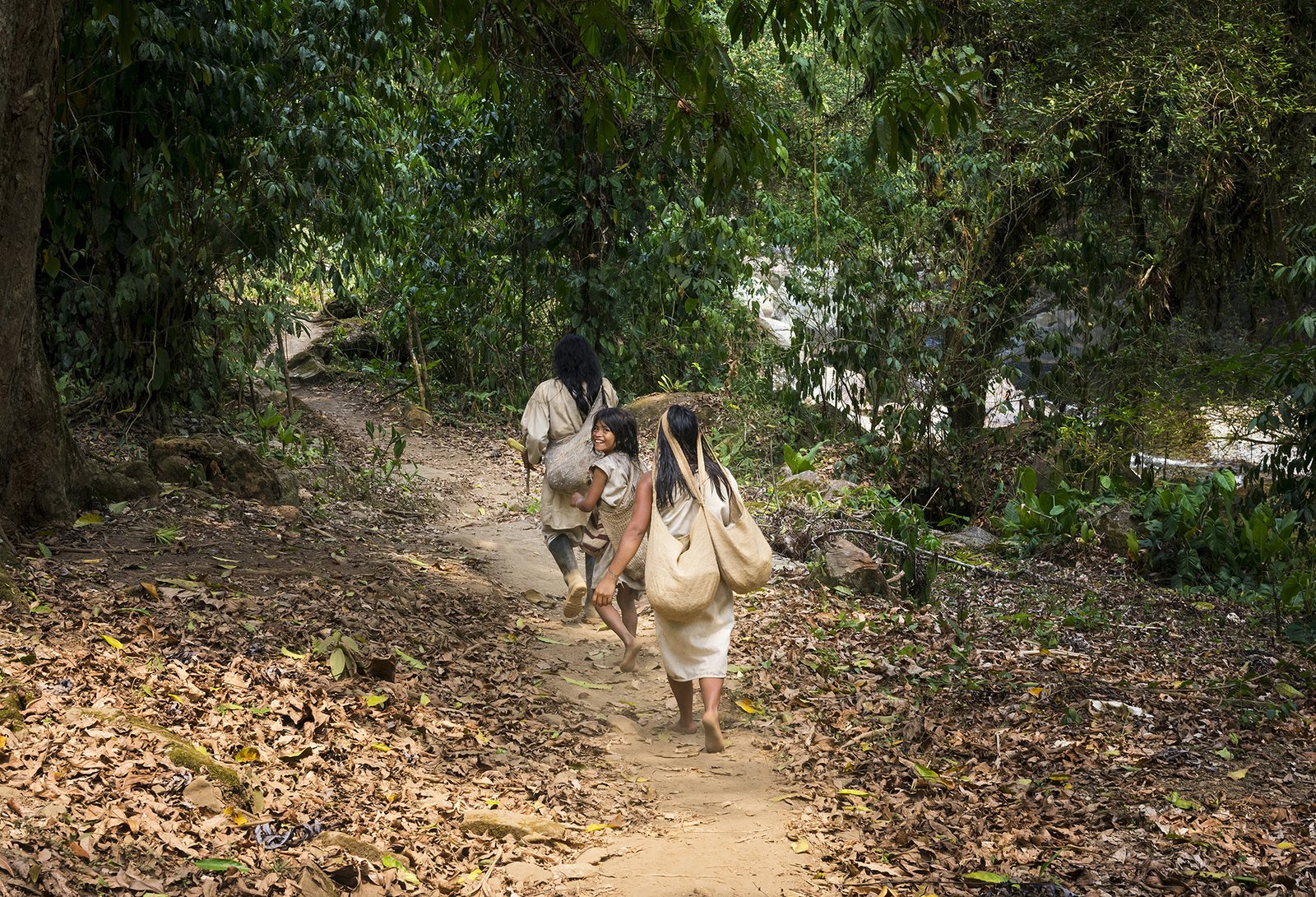
Beyond governments, the process builds on the support of the whole society. Governments sometimes come and go with elections. This process is rooted in the commitment of a range of stakeholder groups who share in the responsibility of moving it forward. In the Academics & Think-Tank chapter, indigenous forms of knowledge creation and Epistemologies of the Global South play an important role to complement, guide and transform mainstream thinking.

Common Questions
The Santa Marta Process emerged in response to a critical gap in international climate governance: the inability of the UNFCCC process to meaningfully address fossil fuels. Rather than replacing the UNFCCC, it complements it by advancing collaboration and practical action on a topic, on which consensus-based negotiations have struggled to make progress: transitioning away from fossil fuels.
The Fossil Fuel Treaty Initiative originally proposed - and then helped organize - the Santa Marta Conference. However, the process evolved into a broader collaborative platform, which recognized that while many participating countries support the Treaty, others do not. It is one important area of discussion within the process, but not its defining framework.
Tuvalu’s role reflects both climate leadership and urgency. As a small island nation on the frontlines of the climate crisis, Tuvalu has not only been a strong voice in the UNFCCC for decades, it is also a strong advocate for ambitious fossil fuel action and binding methane cuts. Tuvalu has offered to co-host the Second Conference co-chairing it alongside Ireland.
At COP30, Brazilian President Lula called for a global roadmap to transition away from fossil fuels. COP30 CEO Ana Toni asked the organizers of the Planetary Science Pavilion at COP30, Johan Rockström and Carlos Nobre, to set up an agile scientific panel to supply the roadmap process with targeted, up-to-date and timely scientific assessment and advice. That’s where the Science Panel for the Global Energy Transition (SP-GET) originated. With the support of the Santa Marta host countries and the Brazilian COP30 presidency, the SP-GET was publicly announced during the Academic Segment of the Santa Marta Conference and is expected to become operational over the course of 2026 and present its first results at COP31. SP-GET will be coordinated from hubs at the Universidade de São Paulo in Brazil and the Potsdam Institute for Climate Impact Research in Germany.
At COP30 in Belem, over 80 countries explicitly supported President Lula’s call for a fossil fuel phaseout roadmap (see above) in an open letter. Blockers stopped the proposal anyway and COP30 ended with a text without an explicit reference to fossil fuels - what has been called “less progressive and science-aligned than our children’s school books”. At the end of COP30, Brazil announced they would organize a voluntary roadmap process on fossil fuels anyway, and report back at COP31 in Antalya. The Santa Marta Conference has complemented and prepared this effort, organizing many discussions on roadmaps (including a two-day Roadmaps Workstream at the Science & Policy Segment - Workstream Summary). Recommendations arose to make sure that national roadmaps complement the global one, and that they include the extraction of fossil fuels, not just their burning, as under the UNFCCC. The SMP can be seen as a coalition of the willing on moving beyond fossil fuels and it is expected that many of its countries will develop national fossil fuel phaseout roadmaps over the next months and years, ideally including some of the Santa Marta principles.
The Science-Policy Community
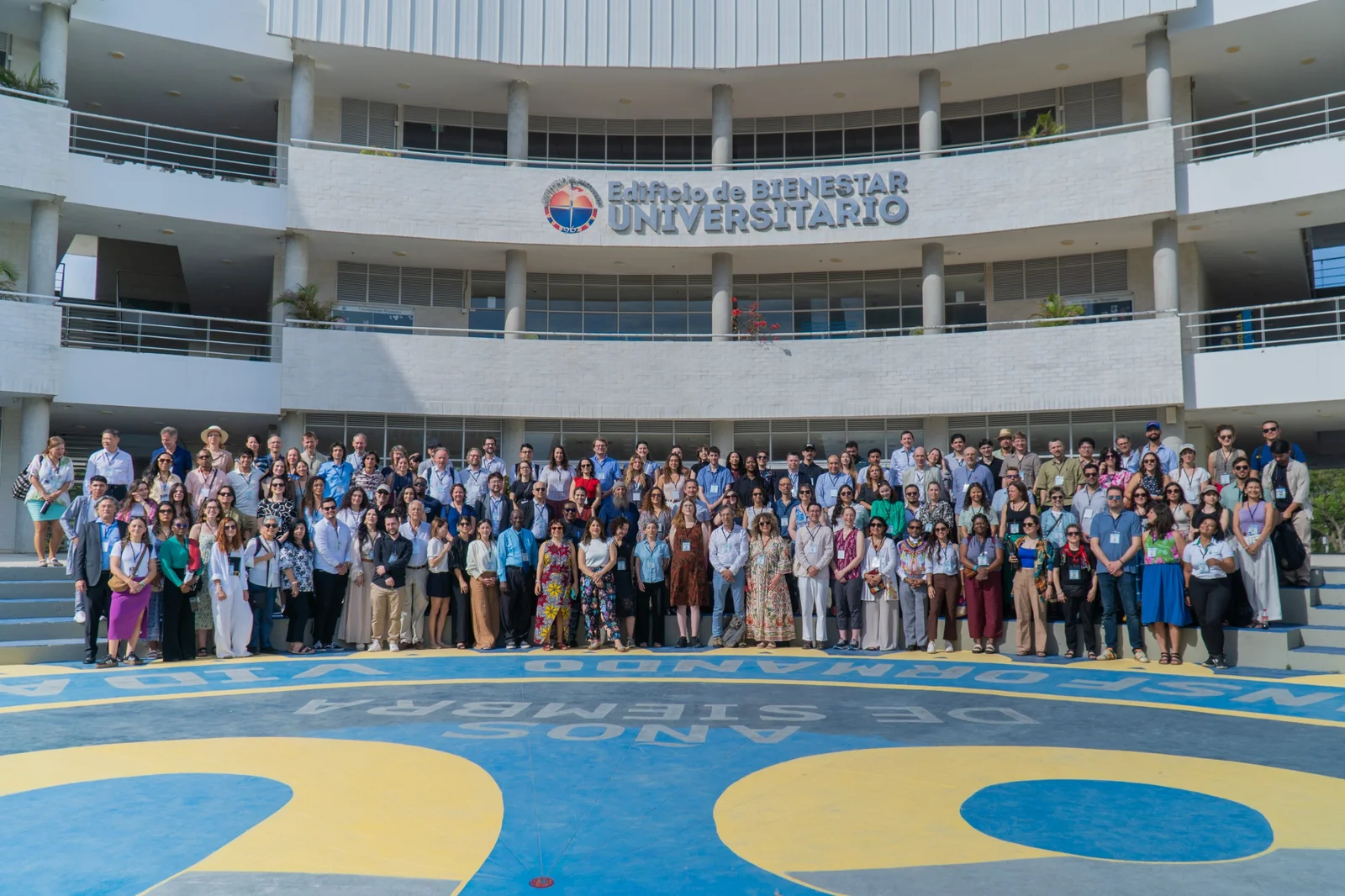
- The Santa Marta Conference opened on April 24-25, 2026 with the First Global Science & Policy Conference on Transitioning Away from Fossil Fuels, the “Academic Dialogue” Segment, ahead of and in parallel with a dozen other stakeholder segments, and before the High-Level Segment on April 28-29, 2026, which closed the Conference.
- The Science-Policy Community that worked together for this occasion consisted of over 400 experts on the ground in Santa Marta, and hundreds more virtually.
- Spectrum of outcomes: Synthesis Paper, Workstream Summaries and Recommendations, SP-GET Announcement, Central Banks SMarT FSG, a Fossil Methane Circle, etc.
Why Santa marta?
Heart of the World
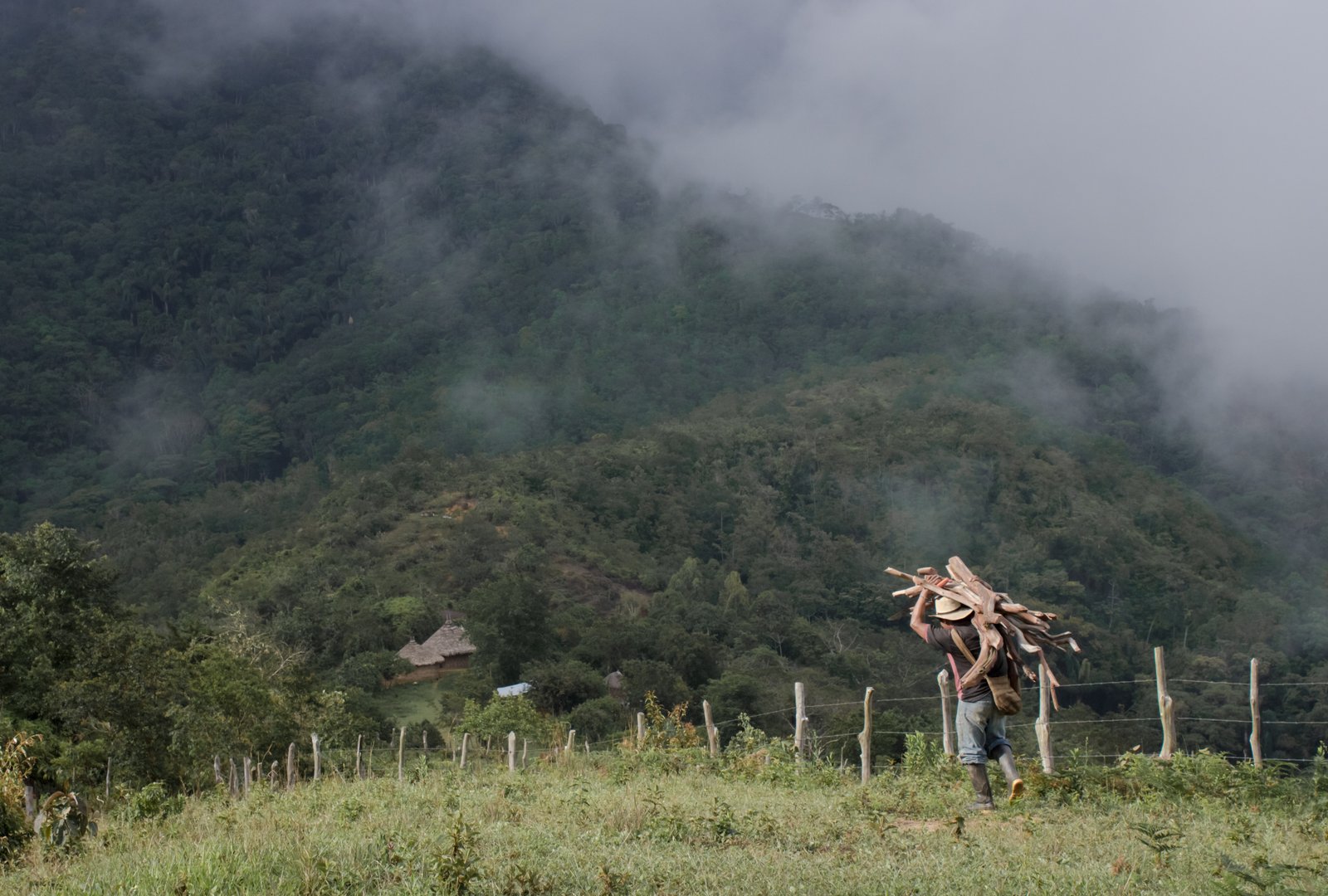
The territory where the Santa Marta Process is rooted, carries deep symbolic meaning. The region that encompasses the Sierra Nevada de Santa Marta and surrounding lowlands and beaches, including the city of Santa Marta, is considered the Heart of the World by the four Indigenous peoples of the region (as beautifully explained in the documentary Tanuzanamu, produced by them – Trailer), whose knowledge system is recognized by UNESCO as Intangible Cultural Heritage. Grounding the process with its First Conference here in the Heart of the World represents interconnectedness, responsibility, and global stewardship on a journey beyond fossil fuels that aims to rebalance the world and move humanity beyond its adolescence into a more mature way of living in harmony and as stewards on this beautiful planet teeming with life.

Stay Updated
Receive updates on the Santa Marta Process and its initiatives.